When someone decides to make a podcast, the first thing they look for is a podcast microphone. That makes sense, because it is the most visible piece of equipment, but the right question is not which microphone is best, but which microphone is best for the place where you will record. An excellent microphone in a room with echo sounds worse than a simple one in a treated room.
This is the first decision and the most important one. A condenser microphone picks up a lot of detail and a lot of space: your voice, but also the echo of the room, the street noise and the kitchen fridge. It shines in studios with good acoustic treatment. A dynamic microphone, on the other hand, focuses on what is right in front of it and leaves out almost everything else. That is why it is the one you see in most video podcasts: it forgives imperfect rooms and lets several people talk close together without each microphone picking up the others’ voices.
If you record at home, in an office or anywhere that has not been prepared, choose a dynamic one. It is the safest option.
The best-known example is the Shure SM7B, the microphone seen on so many radio shows and video podcasts. It sounds wonderful, but it needs a lot of gain, so it calls for a mixing desk or a powerful preamp to perform. There are simpler dynamic alternatives that give a very professional result.
A USB podcast microphone plugs straight into the computer and works with nothing else. It is a good way in if you record alone or with someone remotely. XLR microphones need an interface or a mixing desk, but they are the ones used when several people sit at the same table, because they let you control each voice separately. Some models have both connections, a practical option if you plan to grow.
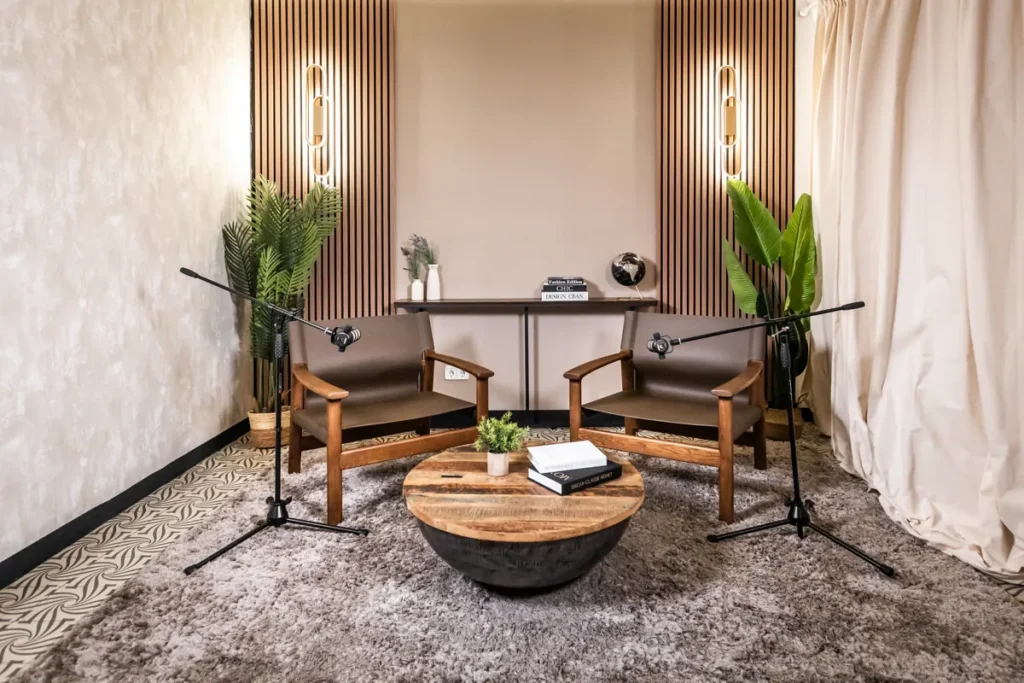
In our two studios we work with five RØDE PodMic dynamic microphones mounted on floor boom arms and connected to a RØDECaster Pro II console. It is a podcast microphone designed for the spoken voice, it rejects surrounding sound well and it looks good on camera, which also matters in a video podcast. Each voice goes on its own channel, so if someone laughs loudly or speaks more quietly, it can be corrected without affecting the rest. We also record a backup track with DJI Mic Mini 2 wireless microphones, in case anything fails. You can see the full setup in podcast studio equipment and the microphone’s specifications on the RØDE website.
The first is distance: speak about a hand’s width from the microphone and keep that distance throughout the recording. If you move away and closer again, your voice goes up and down. The second is the arm: a microphone on an articulated arm sits exactly where it needs to be and does not pick up knocks on the table. The third is the test: before you start, record a minute, listen to it on headphones and fix whatever you do not like. That minute saves hours of editing.
If you are going to record regularly at home, yes, and a mid-range dynamic one is enough to start. If your idea is to record with guests, on video and with a good picture, it will probably pay off more to hire a studio by the hour than to buy microphones, cameras, lights and a desk. We work it out in how much it costs to start a podcast. You can see how it works in podcast recording in Barcelona, and if you are starting from scratch, in how to make a podcast step by step.
And if you are also going to record on video, the next step is the picture: we explain it in which podcast camera to choose.
Written by Adina Harnagea, journalist and co-founder of the studio.